How I Regained My Reading Stamina
I want to give this a punny title. Like a YA book.
“HOW KATHERINE LOST THEIR READING STAMINA AND GOT IT BACK”
Maybe, in the interest of trying to grow this newsletter, I should have called it: HOW TO REGAIN YOUR READING STAMINA IN TEN EASY STEPS.
But I guess a lot of people just go to their LLM of choice these days for that, right? (Even though we know that LLMs and the use of generative AI is actively corroding users’ critical thinking skills.)
But I do want to talk about reading stamina today, because I don’t know about you, but mine has changed drastically in the last six years since the pandemic began.
That’s a strange thing to admit on the internet when your job is WRITER because most people (though unfortunately not all peple) understand that a key component of being A WRITER is being A READER.
And I was a reader long before I was a writer.
Admitting that my reading stamina has changed, that I’m not as good of a reader as I used to be, feels like admitting to a personal shortcoming, a flaw in my character, a moral failing, a hamartia, if you will.
This fall, I decided I needed to fix that.
After all, I reasoned, I became a voracious reader. I was not born one. Could I not become one again?
I’m on Day 42 of this project, and it’s transformed my reading life, and given me back my reading spirit. My joie de vivre. My readerly identity.
Before we get into how I did that, and how you can do it too, let’s start at the beginning.
Disclaimers
No. Wait. We have to start with disclaimers, because this is the internet.
This post is not bashing any genre, or any format of reading. I am talking about my experience and what I noticed, and how other people can take things that I experienced about my reading and apply it to their reading if it resonates with them. If your experience is different—for instance, if you find e-readers increase your reading stamina and you have absolutely no differences in your reading retention on them, good for you! Do not take the fact that my experience is different to be discounting your experience, or an invitation to argue with me. This is truly a YMMV situation. Do not bean soup this.
This is also a long blog post. It'll be challenging to those who are struggling with their reading stamina. Don't feel bad about it. Take it in chunks. I put the lessons I learned at the end, but I am putting one a little higher for you: try reading it aloud, even under your breath, if you find your attention drifting or your ability to focus hampered. It really does help.
Okay, back to what we were talking about.
Before
I come from a family that values reading. I brought books on every road trip or errand—my mom had to regularly remind me and my siblings that we probably didn’t need MULTIPLE BOOKS for going to Acme. We read under the table. We read together in the same room in what we joked was synchronized page turning.
No, seriously, here’s a picture of my family on vacation, all reading in the same room.
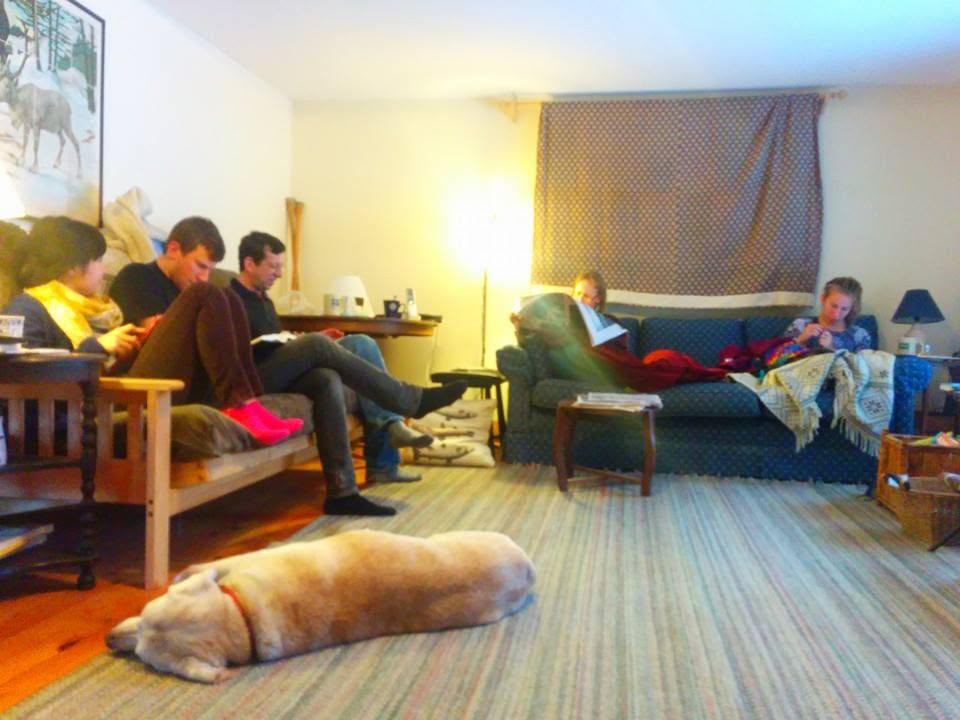
I regularly read over 100 books a year for most of my life, across a wide swath of genres though YA, Romance, and SFF have always dominated my reading.
And I used to read pretty fast. Finishing a 700+ page book in 4-5 hours was not uncommon for me. With reading comprehension!
But those days are far behind us.
The Problem
I have felt this issue for awhile. For the first year or two, I blamed the books. (I know, I know. Yell at me later.) But it became apparent that it couldn’t just be the books. You know those people who read a book and they’re like “it’s a bad book because I didn’t like it” and you’re like, “no, you just didn’t like it, but that doesn’t necessarily mean it’s a bad book”? I realized I was starting to sound like that, to myself, but about too many books. And it couldn’t be all the books.
I was the common denominator.
It was me reading a few pages from each book and just putting it down to pick up my phone.
It was me swiping away from the Kindle app to read that notification or check Threads or Instagram or Facebook or Reddit or wherever else. Trust me, I knew it was getting bad the day I swiped away from a book for a LinkedIn notification for God’s sake.
It was me not finishing books. It was me, not even picking up the physical books that I’d bought. And I was exciting for these books! I wanted to read them. I could feel the interest. I just couldn’t act on the interest.
I was finishing some books—I was bingereading several times a year on Kindle Unlimited (now inexplicably named Kindle+, like they didn’t learn from Google+’s failures). I’d blaze through a romance author’s series in a weekend. Four books. Three days. It was glorious. I loved it.
But I wouldn’t remember any of it. I couldn’t tell you the plots, or distinguish the books apart, or remember characters’ names. And that wasn’t because the books were romance books. That was because I was reading but not absorbing or comprehending. My retention was, frankly, abysmal.
Hi, it’s me, I’m the problem it’s me.
And I’m not alone in this. I taught a Writing Queer YA class last semester at a local university, and I saw this lack of reading stamina in my students. They struggled to finish the books assigned, all YA books, all well written and award winning. Not because they didn’t want to—it was clear from class discussions that they liked the books, they enjoyed them when they were reading them, but finishing the books was challenging.
When I said on Threads I’d be talking about this issue, a number of other authors and readers raised their hands and said me too. I got text messages from friends saying me too.
Our reading stamina is shot.
And it feels weird to admit that because reading is such a foundational part of being an author. It feels almost shameful to admit that I haven’t been reading widely or well, especially in the categories that I write in, because my reading stamina has changed so drastically.
After teaching the semester and being shocked at students’ reading staminas, I started to pay more attention to my own over the summer and into the early fall. It wasn’t just my students. The inkling of “oh no, it’s me, I’m the problem” that I’d been feeling? That was about reading stamina.
So in September, I sat myself down and thought, “If you became a reader before, you can become a reader again.”
So I made a plan.
The Plan
I love a good challenge, a good resolution. I love finite time periods for projects.
I’d seen a youtube video about a 100 day challenge. It wasn’t anything to do with reading, but I was like 100 days! I love that idea. And I had some other goals I wanted to accomplish this fall too. So I made a list of 4 different goals I wanted to do this fall, with reading being one of them. And I wrote them down in a journal and set some boundaries.
I was going to read every single day from a physical book. If I also read an ebook, that was fine, but it didn’t count as my reading for the day. And then I was going to write down in a journal what book I was reading and my reaction to what I was reading.
It was a good plan.
It was, as the corporate world I work in by day, loves to say: SMART. Specific, measurable, actionable, relevant, and time-restricted. I knew when I’d be doing the activity.
But I also needed to see it work in real life.
In Action
When I started to fix my reading stamina, I knew that I needed to stop focusing on the number of books I read every year or even finishing books even though I’d identified those as some of the symptoms of my reading stamina problem.
What I needed to do was focus on rebuilding the stamina, and trust that the number of books and finishing books would fall. It’s like training for a marathon (which I’ve never done but I think it’s a lot like training for a marathon.) You wouldn’t go out and just be mad that you can’t run a mile as fast as you used to run a mile. You’d work on building up your stamina and endurance and trust that the speed and mileage would increase in time.
I also thought that I needed to slow myself down. I found myself trying to read physical books as fast as I was reading ebooks—but reading retention of the material was an issue with me and ebooks, so I knew that the speed wasn’t helping.
To slow myself down, force myself to look at the page and think about the words, and to avoid my phone, I started by reading aloud. I would read aloud to my cats or to myself. This helped me slow down and pay attention to the words.
The other thing I did at the beginning was only read one chapter a night. Even if I was excited about reading more or I wanted to read on, I was trying to be more intentional about the reading. So I forced myself to close the book after just one chapter.
I also restarted my reading by reading a book about reading. Every Day I Read by Hwong Bo-Reum, a Korean Author, is a book about how to get closer to your reading practice, and about why we read and how to read better/more/etc. So I was reading about reading, which also helped. I really enjoyed the book and would recommend it!
I also made it a habit. Even on the nights where I was really tired. Even when I didn’t want to. I made myself read. I would set a timer for 5 minutes and read for just 5 minutes, even if that was only a few pages and not a whole chapter.
And I kept that reading journal I mentioned above. Every day after finishing my reading, I wrote a small paragraph about what I’d read. Sometimes it was about what happened in the book, sometimes it was just a reflection, sometimes I wrote about how excited I was to see what happened in the next chapter, sometimes it was about authorial choices, like why I think the author chose present tense for the book.
Until writing this blog post, I’d forgotten that reading journals were such a crucial tool for elementary school teachers. But now that I’ve done one, I see why. Writing about what I was reading forced me to reflect on it, think about what I’d written, and improved my reading retention and comprehension. When I read those entries back, I can see myself putting together the pieces of the story and writing.
It also helped to remind me why I loved reading. Writing about what was exciting, what was heartbreaking, what was interesting and intriguing, how the author wrote the story, etc all reminded me of what I loved about reading, what kept me reading, why I love stories so much, and why I return to the page.
The Results
I’m 42 days into this project, so a week shy of halfway, but I can already tell you it’s a success. I’ve read more in 42 days than I had in the previous six months but more importantly, I remember what I’ve read, and I can tell you about what I’ve read, and I’m excited about what I read. It feels like a joyful practice again.
And my reading stamina has improved—I was at jury duty on Monday and I could have scrolled my phone for 6 hours, but instead I read The Sixth Faction by Veronica Roth in a single sitting. I barely picked up my phone at all. I could have scrolled—I brought headphones, I had a battery pack so my battery wouldn’t drain. But I didn’t.
My ability to focus on my reading is starting to return, day by day.
I am still reading e-books. I read a series the other day! But I am not counting that toward my reading every day, and I can really feel the retention difference now that I’m reading physical books every single day. I still find I have poorer retention for ebooks. That’s in line with most of the research about reading and ebooks. I don’t think I’ll stop reading ebooks, but I’m more mindful about when I’m choosing an ebook over a physical book because of this issue.
When I was measuring and reflecting on my reading stamina over the summer, I also realized I’d been reading mostly books that my brain, inundated with bad news, stress, and work, found easy to digest.
So I have also been reading books that I’ve been wanting to read, but felt were “too much” for me right now. By slowing down, writing reflections, and taking my time, I found that even though the political news, work stress and hectic schedule haven’t changed, my brain can in fact handle a complex book.
It’s doable.
You can in fact fix your reading stamina.
You just need to make a plan, and hold yourself accountable.
You Can Do It Too
1. Make a plan and set a goal for your reading, just like I did.
2. Find a way to give yourself a checklist, a checkbox, a star chart, whatever. It helps. I promise.
3. Keep a reading journal.
4. Read aloud to help slow yourself down and be intentional.
5. Set a timer and read for 5 minutes, even on the bad days or hard days.
6. Don’t read until you’re burn out. Stop after a chapter. Rebuild slowly.
7. Keep your phone face down/behind you/elsewhere during your daily reading time.
8. Use a Brick device if you need to set with a specific schedule.
9. Play music/wear headphones while you read, if that will help separate you from the real world (this helps me)
10. Hold yourself accountable. There will be days where you think “ugh, I don’t even want to do 5 minutes. I don’t have 5 minutes.” Set the timer for 2 minutes. 1 minute. Whatever it is, make it happen every day.
At the beginning, I was sulky. At myself. I was like, “I am treating myself like a CHILD. I am an ADULT. I don’t NEED this.”
But the reality is I did need it. And I know I needed it because it worked. Because I like a challenge, a checkbox, a sticker, a feeling of accomplishment, and I needed to retrain my brain to focus on a book, slow down to rebuild stamina, and stop letting the shame and the feeling of the kind of reader I used to be prevent me from becoming that reader again, or a new kind of reader.
And I’m going to keep going with the challenge—58 more days to go!—and I suspect I’ll keep up the reading journal after the challenge. I think for me, that’s been one of the best parts of this self-made challenge and effort to rebuild my stamina.
I’d love to hear what you’ve been doing to rebuild your reading stamina, and what you might be trying to fix your reading stamina, in the comments.
This weekend is the best time to start.
Sincerely,
Katherine
Resources for Additional Reading
https://www.taylor.com/blog/printed-books-are-proven-to-improve-reader-comprehension
https://www.psychologytoday.com/us/blog/well-read/202402/the-case-for-paper-books-vs-e-readers
https://news.harvard.edu/gazette/story/2026/06/many-children-like-ebooks-experts-cast-a-wary-eye/
https://news.harvard.edu/gazette/story/2026/10/reading-decline/
https://www.edweek.org/teaching-learning/how-to-build-students-reading-stamina/2024/01
Member discussion